
How do you finish a handwoven merino lambswool fabric to create a luxury scarf

Updated: Aug 4

The final transformation of creating a handwoven scarf happens during the finishing process when water, movement, and careful handling bring the fabric to life. This blog discusses the final finishing steps to transform a handwoven merino lambswool fabric into a beautiful luxury scarf or snood. When handwoven merino lambswool fabric is cut from the loom, the weaving itself is only part of the story. The threads have been held under tension during the weaving process, and although the handweaving is finished, the fabric is yet to reach its true potential and this is why the finishing process is so important.

Woven merino lambswool fabric does not look great on the loom!
When I first started to weave with fine merino lambswool on the loom there were many times when I didn’t like the look of my weaving! Whilst the luxury yarn finishes beautifully it neither looks good and certainly doesn’t feel good on the loom. The fine yarn is fragile and to provide a little more stability it is spun with spinning oils which give the yarn a rough feel on the cone and loom.

The other thing that I have come to learn from weaving with this particular yarn is that it is important that the weaver leaves something for the finishing process to do its magic. Upon finishing the fibres shrink and felt bringing the fibres closer together. In order to create a stunning scarf which has a wearable drape the fibres need to be woven at a sett to create these gaps on the loom which are later filled. This means that on the loom it has to be accepted that the fabric doesn’t look as beautiful as it will when finished. I have learnt to have faith in the final finishing process.
Removing the handwoven fabric from the loom
Once the weaving is complete, the fabric is carefully cut from the loom. At this stage the structure of the cloth is still quite open, and the individual warp and weft threads are clearly visible. The fabric may feel slightly stiff or uneven, because the fibres have not yet relaxed into their final form. This moment is exciting as I am now able to see the final pattern but as a cloth it still has several more essential stages to go through before it becomes a beautiful accessory.

Repairing weaving errors and broken threads in handwoven fabric
Broken threads, knots and missing threads are common when using this fragile yarn so before the fabric is wet finished these errors need to be repaired. This is done by hand using a tapestry needle. I weave in new threads or broken threads to create an integral woven pattern.

Wet finishing and fulling of a merino lambswool scarf
The most important step in finishing a handwoven wool scarf is the wet finishing. Immersing the cloth in water allows the fibres to relax and settle after being held under tension during the weaving process. As the fibres absorb the water, the detergent removes the spinning oils causing the fabric to bloom. The fibres soften and begin to shift slightly, allowing the structure of the fabric to stabilise as the wool fibres shrink and felt together to create a fabric where the fibres move together, rather than as separate threads.

I am really careful during this process. If the fabric is agitated too much or the temperature of the water changed then over felting can occur. Over felting creates a less than luxurious fabric with little drape. It is a fine balance between removing all the spinning oils and over felting with the goal being to create a balanced cloth with softness, drape and warmth.
Rinsing and drying a handwoven fabric
Once the desired texture has been achieved, the fabric is rinsed in clean water to remove the soap. Excess moisture is gently pressed out and I then do a quick spin in my washing machine for less than the normal spin cycle but just long enough to remove the excess water. Alternatively I may roll the fabric between a large towel to removed this excess moisture. The fabric is then hung carefully to dry, preferably on a windy day.

Pressing and final finishing of a handwoven fabric
When the scarf is nearly dry, it is lightly steam-pressed. Pressing smooths the surface of the cloth and enhances the natural lustre of the wool fibres. It also sets the final shape and drape of the scarf. At this point the transformation is complete. What began as interlaced threads have become a soft, cohesive textile. Loose fibres are snipped and the selvedge edges tidied if necessary.

The transformation is complete - a stunning merino lambswool handwoven scarf has been created.
Finishing is often described by weavers as the moment when the fabric truly becomes cloth. Through water, warmth and careful handling, the fibres relax, the weave settles, and the full character of the material emerges.

For a handwoven merino lambswool scarf, this final stage reveals everything the weaving has promised: softness, warmth, texture, and the quiet luxury of a textile made slowly by hand. The blog: How to care for a lambswool handwoven scarf now explains how best to look after your luxury accessory.
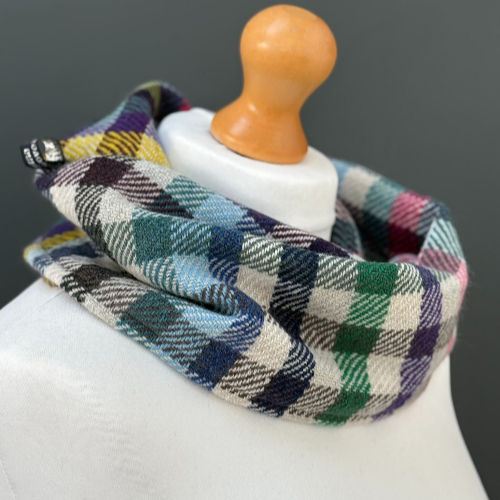
My handwoven scarves, shawls, snoods, and other accessories are for sale in my website for UK, Canada and USA delivery.
If you are interested in knowing what is on the loom, off the loom, and workshop dates, do sign up to receive my weaving news emails by clicking here.


